

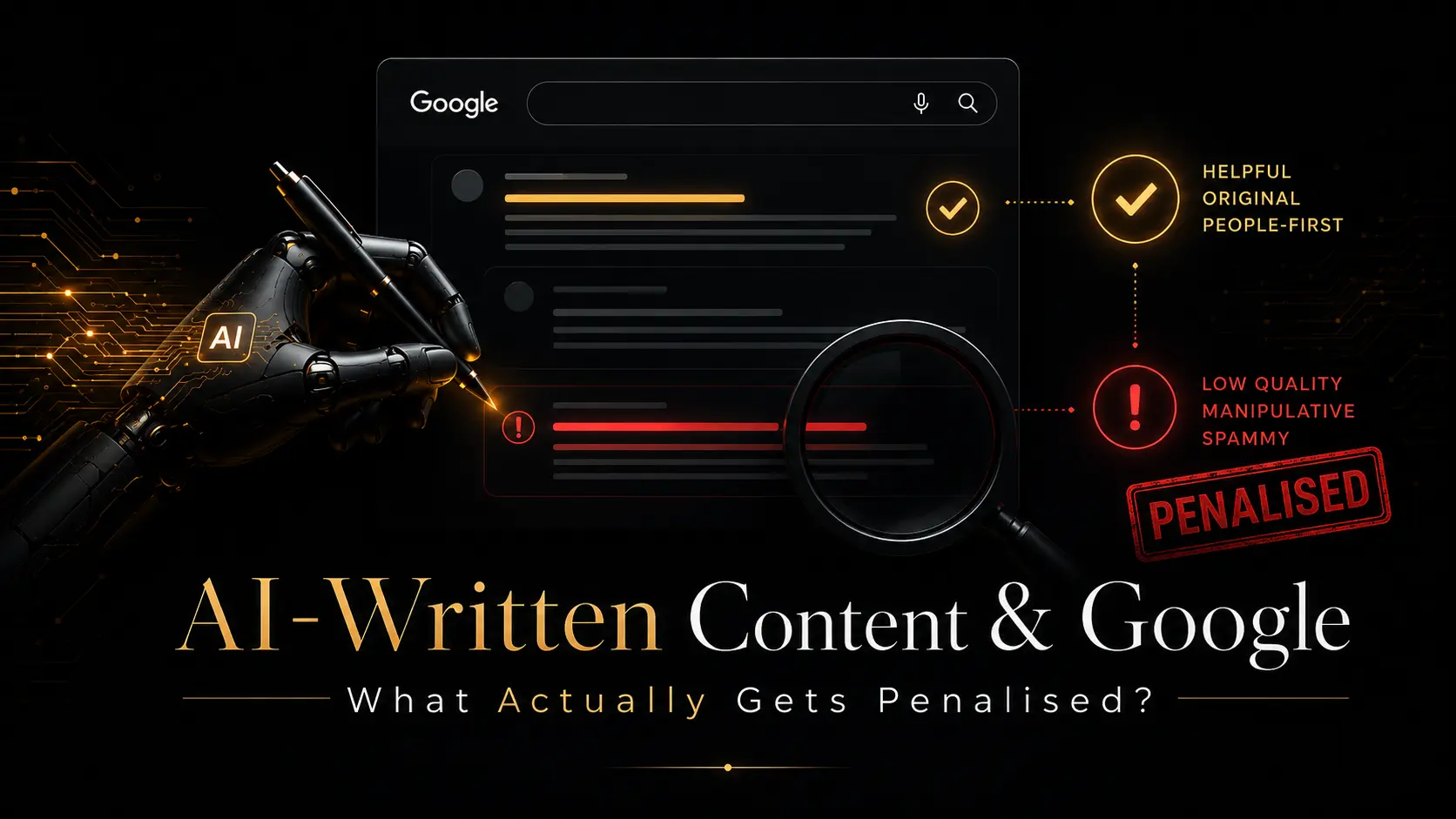
Every week someone asks whether Google punishes text written by a model. The short answer is no. AI-written content is not banned, and it never was. However, Google does act against content produced at scale with no purpose beyond ranking, and most bad AI output falls straight into that bucket.
What Google actually says about AI-written content
The rule lives in the spam policies, and it targets intent rather than tooling. Text made mainly to manipulate rankings is spam, whoever or whatever typed it. So a thin article assembled from three competitors is a problem. A careful guide drafted with a model and edited by someone who does the work is not.
This is why the E-E-A-T signals matter more than the byline. Experience, expertise, authority and trust are judged from what the page demonstrates. For example, a hosting comparison written by someone who has actually migrated sites reads differently, and it earns links that a generic summary never will.
Where AI drafts go wrong
- Confident errors. Models invent version numbers, prices and quotes. Check every one.
- No first-hand detail. If the piece could describe any company, it will rank like any company.
- Sameness at volume. Twenty near-identical posts train readers to skip you.
- Dead links. Cited sources are often plausible and imaginary at once.
- Wrong register. A Greek audience reading translated marketing English can tell immediately.
None of those failures come from the model itself. They come from publishing the first draft. Therefore the fix is editorial rather than technical, and it costs far less than a recovery after a ranking drop.
A workflow that survives an update
Use the model where it is strong: outlines, first drafts, tightening a paragraph that will not behave. Then add what only you have. That means real numbers, a client story, a screenshot, an opinion you would defend in a meeting. Finally, have a human sign it off, because someone must be accountable for the claims.
In short, publish nothing you would not put your name on. That single test filters out almost everything Google objects to. If you are also wondering how models decide what to cite, read our take on refreshing old blog posts and on converting the visitors you already have. Our content team works this way daily.