

Most Greek business sites launch with a contact form and nothing else. Then a customer asks about returns, or a supplier asks who they are actually contracting with. The legal pages are the least glamorous part of a website, yet they are the part that decides whether a dispute is boring or expensive. So it is worth an hour.
The legal pages you actually need
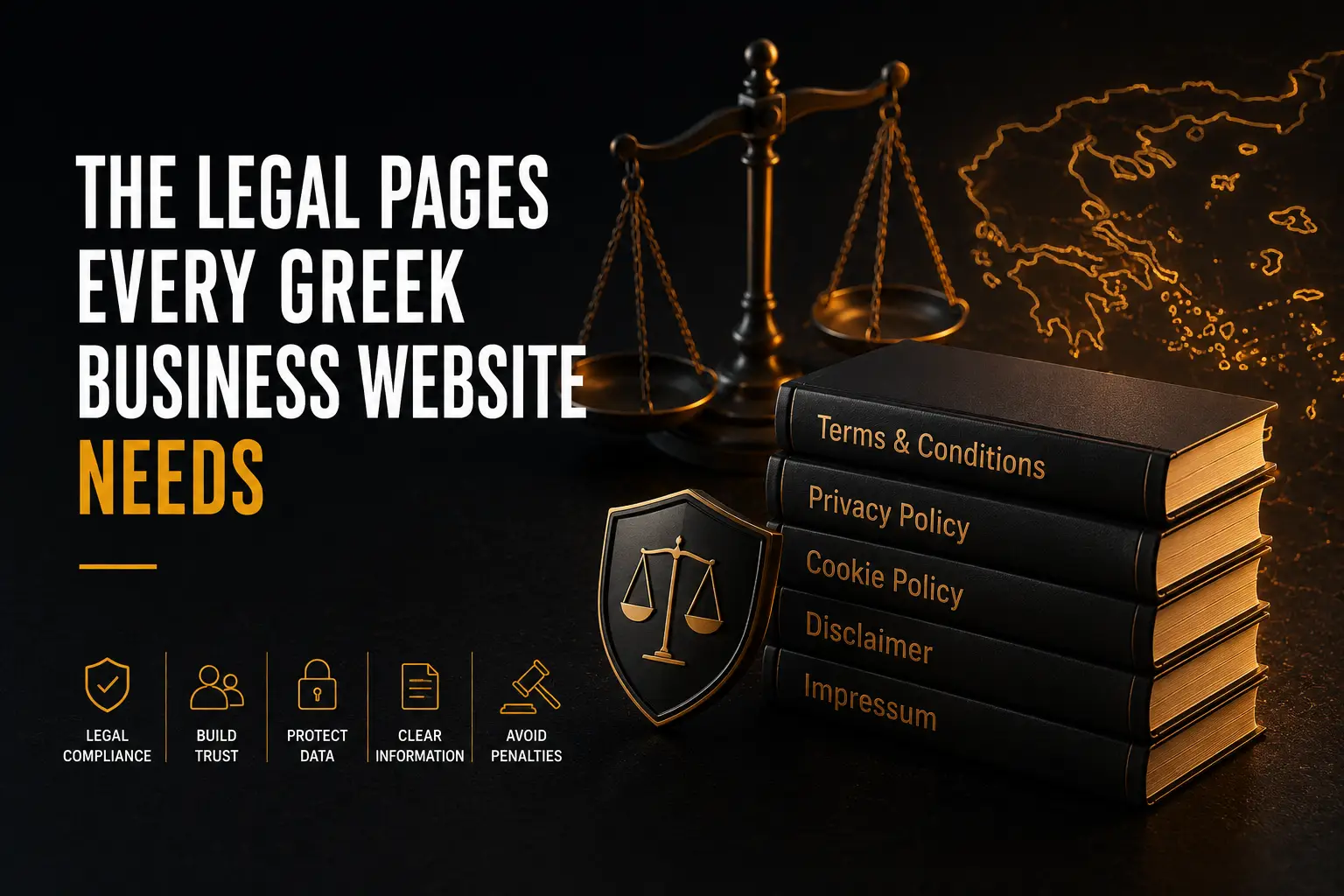
- Company identification. Legal name, address, ΑΦΜ, ΓΕΜΗ number and a real contact route. This is a straightforward transparency requirement, not a style choice.
- Privacy policy. What you collect, why, how long you keep it and who else sees it.
- Cookie policy. The companion to your banner, listing categories and purposes.
- Terms of use. The rules for using the site itself, including your liability limits.
- Terms of sale. Only if you sell online, and then it must cover delivery, payment, returns and the fourteen-day withdrawal right.
An e-shop also has to show the total price including VAT before checkout, plus any delivery cost. Therefore hiding shipping until the last step is not just annoying, it is a compliance problem.
Where copied templates go wrong
A downloaded privacy policy usually names processors you do not use and misses the ones you do. For example, if you run a newsletter, a booking tool and a chat widget, each of those touches personal data and belongs in the document. In addition, the policy must match reality. Promising to delete data in thirty days while your backups keep it for a year is worse than saying nothing.
The European Commission’s data protection guidance is a reasonable starting point, but treat it as a checklist rather than a text to copy.
Keep them findable and current
Link every legal page from the footer of every page, in both languages if you run a bilingual site. Next, put a review date in your calendar, because these documents drift as soon as you add a tool. Above all, write them in language a customer can read, since a wall of untranslated boilerplate protects nobody.
In short, legal pages are cheap insurance and a trust signal at the same time. Pair them with a compliant banner as described in cookie consent done right, and check what your forms actually collect using website to CRM integration. Our team builds these pages into every site we ship.