
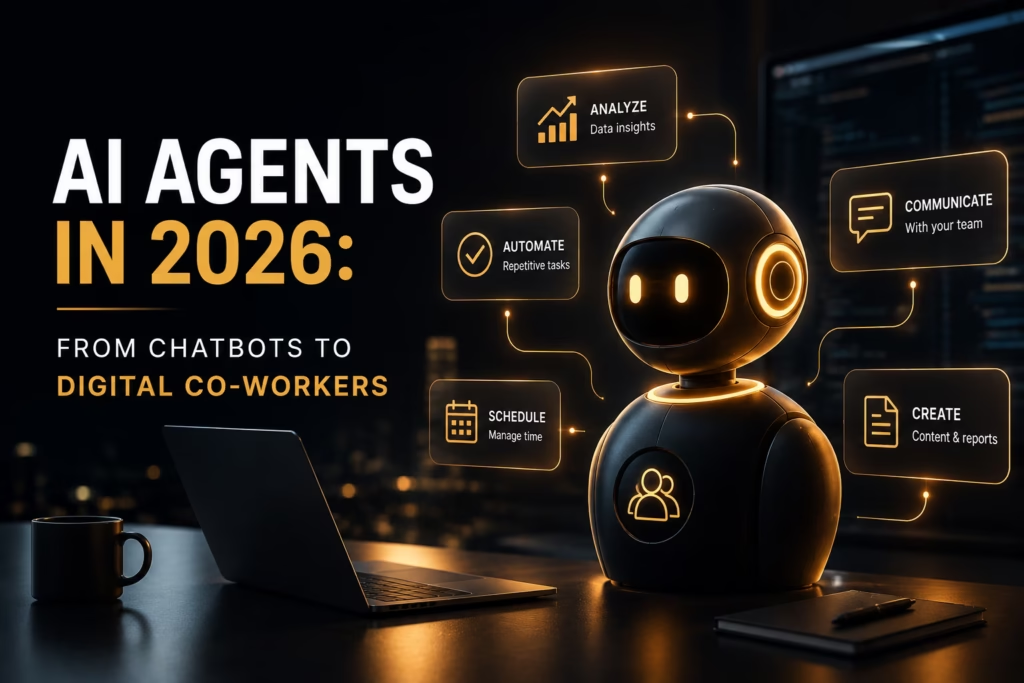
Artificial intelligence has undergone a remarkable transformation over the past few years. What began as simple conversational chatbots has evolved into a new generation of AI agents capable of performing complex tasks, making decisions, and assisting users in ways that were once considered science fiction.
As major companies continue to invest heavily in artificial intelligence, AI agents are becoming one of the most important technological trends of 2026.
What Exactly Is an AI Agent?
Unlike traditional chatbots that primarily respond to questions, AI agents are designed to take action. They can research information, analyze data, generate content, write code, organize workflows, and even interact with external tools and services.
The key difference is autonomy. Rather than simply answering a prompt, an AI agent can break down a goal into multiple steps and work toward completing it with minimal human intervention.
For businesses, this means AI is no longer limited to customer support or content generation. It is increasingly becoming a digital assistant capable of contributing to daily operations.
Recent Advances in AI Capabilities
The latest generation of AI models has introduced significant improvements in reasoning, memory, tool usage, and multimodal understanding. Modern systems can process text, images, documents, and other forms of information simultaneously.
Companies such as OpenAI, Anthropic, Google, and others are continuously expanding the capabilities of their models, enabling more sophisticated workflows and reducing the amount of manual effort required from users.
These developments are paving the way for AI systems that can assist professionals across industries, including software development, marketing, education, design, and research.
How Businesses Are Using AI Agents
Organizations are already exploring practical applications for AI agents. Common use cases include:
- Automating repetitive administrative tasks.
- Assisting with software development and debugging.
- Generating marketing content and campaign ideas.
- Conducting research and summarizing large volumes of information.
- Improving customer support operations.
- Streamlining internal documentation and knowledge management.
For small and medium-sized businesses, AI agents can provide access to capabilities that previously required dedicated teams or specialized expertise.
Challenges and Limitations
Despite their rapid progress, AI agents are not perfect. Accuracy, privacy, security, and reliability remain important considerations.
Businesses adopting AI solutions must establish clear review processes and ensure that critical decisions continue to involve human oversight. AI can significantly improve productivity, but it should be viewed as a powerful assistant rather than a complete replacement for human expertise.
Looking Ahead
The transition from chatbots to AI agents represents one of the most significant shifts in modern computing. As models become more capable and integrated with digital tools, businesses and individuals will gain access to increasingly powerful forms of automation.
While the technology continues to evolve, one thing is becoming clear: AI agents are no longer a glimpse of the future. They are rapidly becoming a practical part of everyday work.