

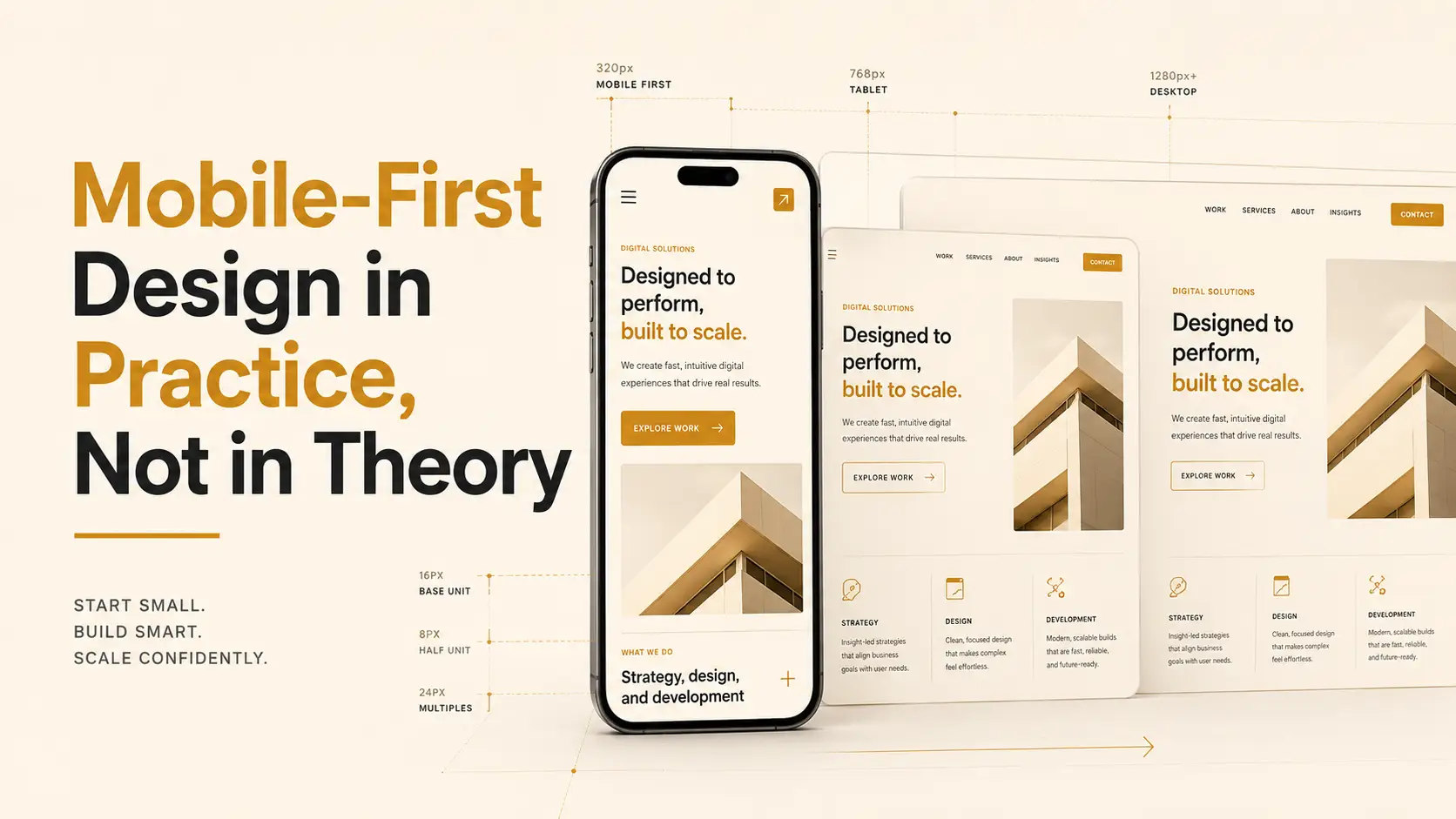
Almost every agency claims it. Far fewer actually do it. Mobile-first design does not mean the desktop layout squeezes down without breaking. It means you decide what matters while the screen is still small, and only then work out what to do with the extra room. So the order of the work is the whole point.
Why mobile-first design changes the outcome
Start on a wide canvas and everything fits, so nothing gets cut. Start narrow and you are forced to rank. That ranking is the valuable part, because it is the same decision your customer makes in the first three seconds.
Google indexes the mobile version of your site, so what you hide on small screens is effectively what you told Google you do not need. Therefore “we will simplify it for mobile” quietly means “we will simplify what search engines see”.
The rules that survive contact with real users
- One primary action per screen. Call, book, buy. Two competing buttons means neither gets pressed.
- Thumbs, not cursors. Put the main action within reach of the bottom third of the screen.
- Tap targets of at least 44 pixels. Anything smaller punishes people with larger hands or shaky grip.
- Real text, not text in images. It scales, it translates and screen readers can reach it.
- Forms that use the right keyboard. A numeric pad for a phone number is a two-second fix nobody makes.
Meanwhile, test with one hand while walking. It sounds unserious, yet it exposes more problems than any emulator. The responsive design basics from Google cover the technical side once those decisions are made.
Where mobile-first usually breaks
Navigation is the usual casualty. A menu that hides eleven items behind a hamburger is not simplification, it is concealment. Instead, cut the menu to five and let the footer carry the rest. Tables are the other one, because a price list built for a spreadsheet never survives a phone. Rebuild it as cards.
In short, mobile-first is an editing discipline wearing a technical name. It pairs directly with speed, so read Core Web Vitals in 2026 next, and then why a beautiful website still fails to convert. Our design team works this way by default.