
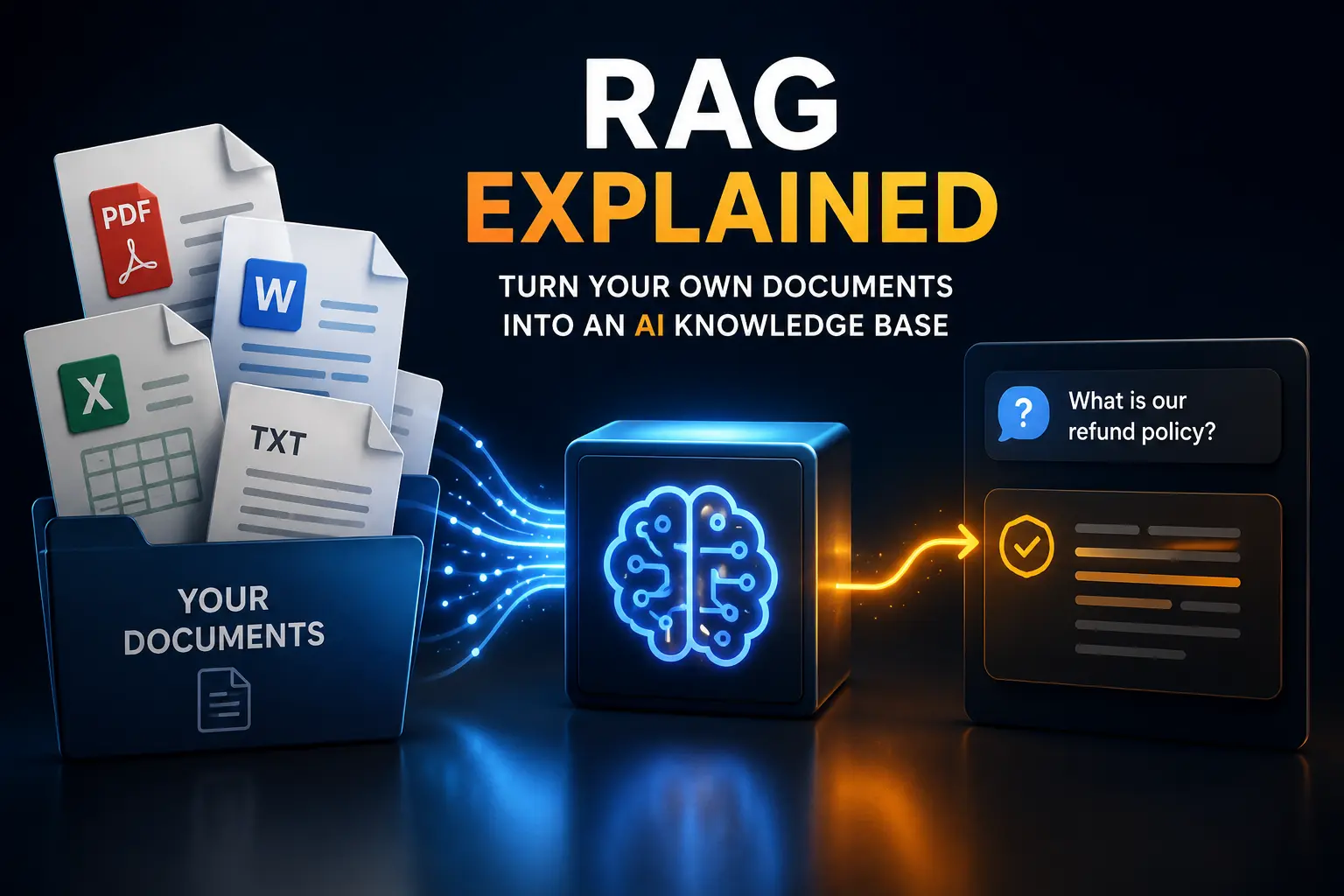
Ask a general AI model about your company’s return policy and it will invent something plausible. Feed it your actual policy first, and it will quote you correctly. That gap is the whole reason an AI knowledge base exists, and the technique behind it has an ugly name: retrieval-augmented generation, or RAG. Fortunately the idea is simpler than the acronym suggests.
What an AI knowledge base actually is
Think of a very capable new colleague who has read the entire internet but not one page of your filing cabinet. RAG hands them the right three pages before they answer. Mechanically, your documents are split into passages, converted into numeric vectors that capture meaning, and stored in a searchable index. Then, when a question arrives, the system retrieves the closest passages and passes them to the model along with the question. As a result, answers stay grounded in your own material — and can cite it.
Why not just train a model on your data?
Fine-tuning teaches a model style, tone and format. However, it is a poor way to teach facts. Facts change, and retraining every time your price list moves is absurd. Meanwhile RAG updates instantly: change the document, reindex it, done. In addition, retrieval leaves an audit trail, because you can see which passage produced which sentence. Therefore most business systems use RAG for knowledge and reserve fine-tuning for voice.
Where these projects go wrong
- Messy sources. Three contradictory versions of the same policy produce three contradictory answers. Clean the documents first — that is the real work.
- No dates or owners. Without them, the model cannot prefer the current version.
- Bad chunking. Splitting mid-table or mid-clause destroys meaning, so retrieval returns fragments that read like nonsense.
- No citations. If staff cannot check the source, they will not trust the tool.
- Ignored permissions. Never index salary files into a bot that anyone can query. Retrieval must respect who is asking.
Anthropic’s write-up on contextual retrieval is a good technical read on making retrieval accurate rather than merely present.
Where it pays off first
Start where the same question gets answered repeatedly. Customer support is the obvious case: shipping, returns, compatibility, warranty. Internal onboarding is the quiet winner, because new staff stop interrupting senior colleagues. Tender and proposal work benefits too, since half of every response already exists somewhere. Meanwhile a support bot built this way beats a scripted chatbot, as we argued in should you add an AI chatbot.
What it costs, honestly
The model calls are usually the cheap part. Preparing documents, deciding what counts as authoritative and keeping the index fresh take real hours. So budget for maintenance, not just a build. Also pick a model tier that matches the task — a mid-tier model with good retrieval beats a flagship model guessing, a point we made in how to choose an AI model. And remember why this asset matters: your documents are the part competitors cannot copy, which is the argument in data is the new moat.
Done properly, an AI knowledge base turns scattered PDFs into something your team and your customers can actually query. Done carelessly, it launders your worst documents into confident prose. If you want the first version scoped tightly — one department, cited answers, no surprises — our team builds exactly that.