

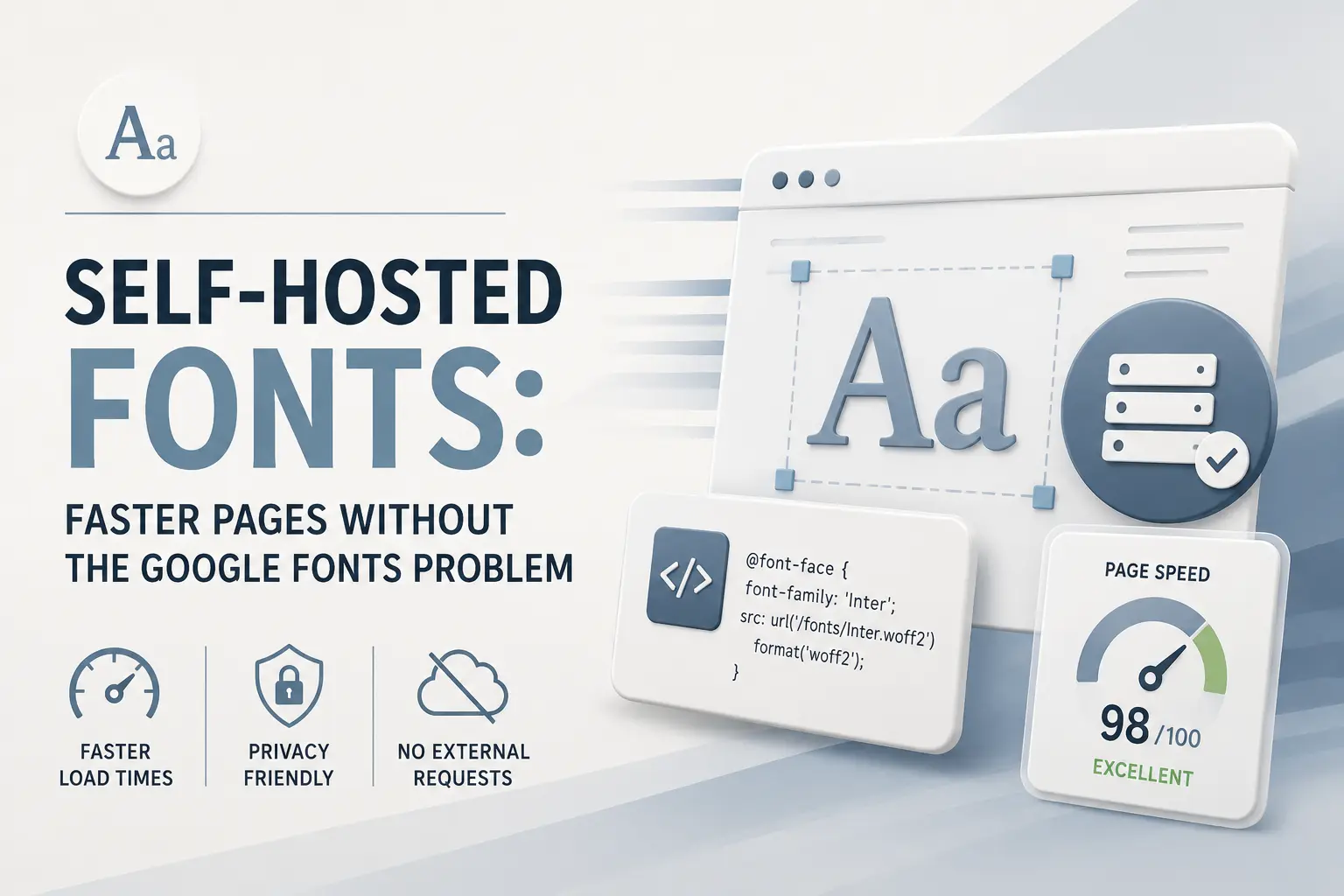
Your fonts load before your text does, so they decide how fast a page feels. Self-hosted fonts put those files on your own server instead of pulling them from Google. The change takes an afternoon. However, it touches speed, layout stability and privacy all at once, which is rare for such a small job.
Why self-hosted fonts beat a CDN request
First, the network. A Google Fonts link means a fresh DNS lookup, a new TLS handshake and a second round trip before a single letter appears. Browsers stopped sharing font caches between sites years ago, so that cost lands on every visitor. Therefore the “it will already be cached” argument no longer holds.
Next, stability. When a font arrives late, the browser repaints your text and the layout jumps. That jump is measured as Cumulative Layout Shift, one of the metrics we cover in Core Web Vitals in 2026. Serving the file from your own domain removes the slowest part of the chain. As a result the text paints once, in the right face.
The privacy angle nobody mentions
A remote font request also sends your visitor’s IP address to a third party. German courts have already fined site owners over exactly that. So if you have spent effort on your cookie banner, leaving fonts on someone else’s server is an odd gap. Self-hosting closes it without any consent prompt at all.
How to move without breaking the design
- Take only what you use. Two weights usually cover a whole site. Every extra weight is another file.
- Use WOFF2 only. Every current browser supports it, so older formats are dead weight.
- Subset the character range. Greek and Latin can ship as separate files, so English visitors never download Greek glyphs.
- Preload the first face. One
<link rel="preload">for the font used above the fold, and no more. - Set
font-displaydeliberately. Useswapfor body text andblockfor headings you cannot let flash.
Google’s own font best practices recommend the same sequence. Meanwhile, watch the total: if your fonts weigh more than your images, something has gone wrong.
In short, self-hosted fonts are one of the few changes that make a site quicker, steadier and cleaner in one pass. If you would rather not touch the CSS yourself, our web team handles the swap as part of a speed pass. For the wider picture, start with why load time quietly kills conversions.