
Every hosting page promises 99.9% uptime, and almost nobody checks what that number allows. Website uptime is simple arithmetic, so let’s do the arithmetic — then look at the small print, and at how to find out about an outage before your customers tell you.
The maths behind website uptime
A 30-day month contains 43,200 minutes. Therefore:
- 99% allows 432 minutes down per month — over seven hours.
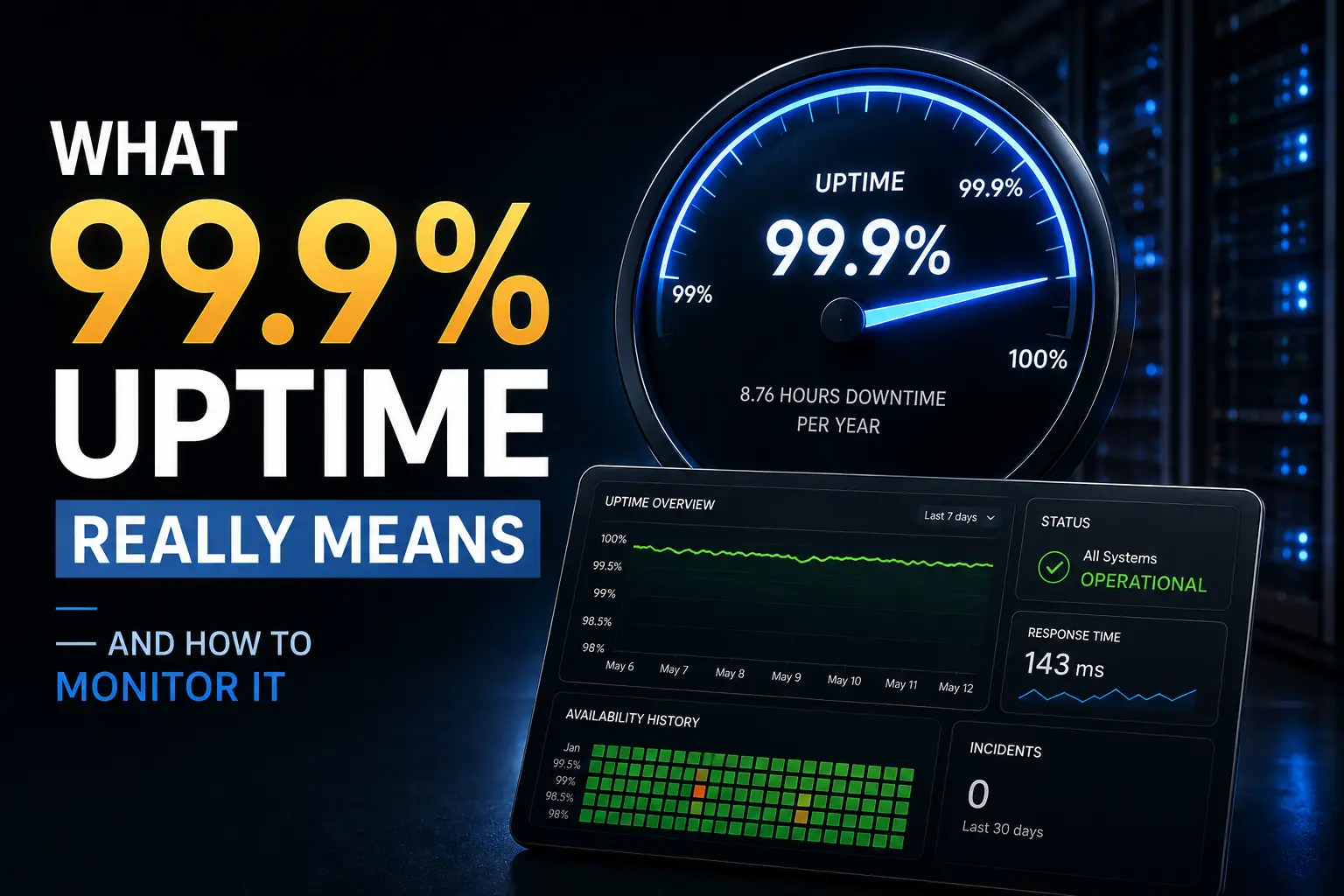
- 99.9% allows 43.2 minutes per month, which is about 8 hours 46 minutes per year.
- 99.99% allows 4.3 minutes per month.
So “three nines” is a reasonable promise for a business site, while “two nines” means a working day of downtime each year. Google’s SRE team publishes a fuller availability table if you enjoy this sort of thing. Meanwhile remember that the average matters less than the timing: 40 minutes down at 03:00 costs nothing, and 40 minutes during a campaign costs real money.
What the small print usually says
Read the service level agreement before you rely on it. First, check who measures — if the host measures itself, your evidence counts for little. Second, check the exclusions: scheduled maintenance, attacks, third-party networks and “customer code” are all commonly carved out. Third, check the remedy. Almost always you receive service credits rather than compensation, and you must claim them within a short window. Consequently the SLA is a signal of seriousness more than an insurance policy.
Monitoring that actually catches problems
Here is the part most businesses skip. Monitor from outside your own network, every minute or two, from at least two locations. However, do not stop at the HTTP status code, because a fatal PHP error can return a perfectly happy 200 with a blank page. So check for a string that must appear — your phone number in the footer, for example. In addition, monitor these four things:
- SSL certificate expiry, which takes sites down more often than hardware does.
- Domain renewal date, ideally with the renewal on a card that will not expire quietly.
- One critical transaction — a login, a search or a test checkout — because a shop can be “up” and unable to sell.
- Email delivery, since silent form failures look like a quiet week.
Then route alerts to a phone, and to a second person. Finally, keep a short incident log with dates and durations. As a result, at renewal time you negotiate with evidence rather than impressions — and you know whether the signs it is time to migrate apply to you.
Uptime is not the same as working, and it is not the same as fast. A site can be reachable, slow and broken all at once. That is why monitoring belongs beside the routine described in why your website needs regular maintenance, and why we set it up alongside every launch. If you want monitoring, alerts and a monthly report configured for your site, our team can add it this week.