
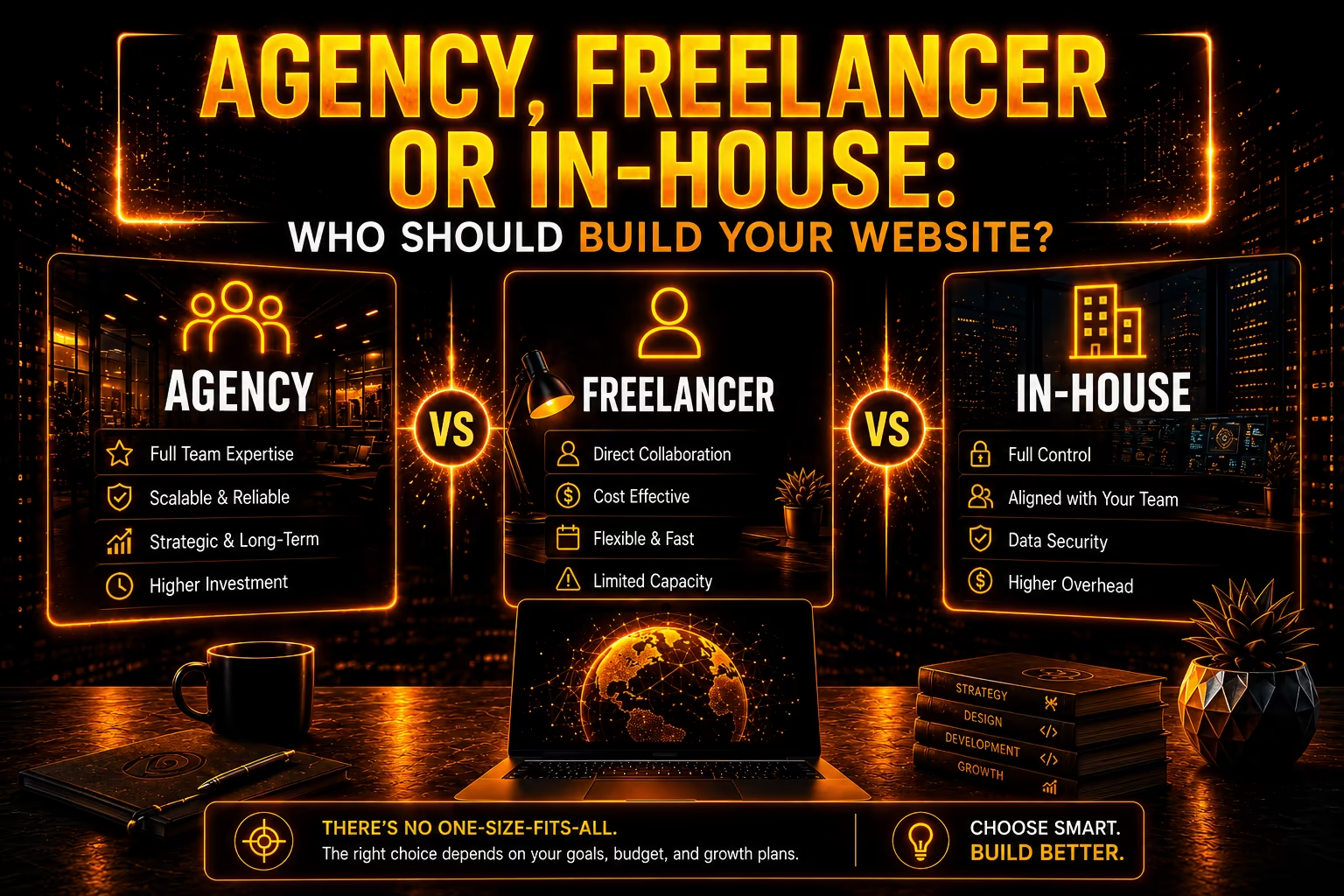
Three quotes land in your inbox: a freelancer at €1,500, a web agency at €6,000, and a suggestion from your nephew that you hire someone internally. All three can be the right answer. The difference lies in how much work you will have after launch, and how much of the risk you want to carry yourself. So let’s make the choice concrete.
The freelancer: cheapest, and fine more often than agencies admit
A good freelancer gives you direct contact with the person doing the work, lower overhead and quick decisions. For a five-page site, a small shop or a specific fix, that is often the smart purchase. However, one person has one skill set and one calendar. So ask who covers holidays, illness and the week your site breaks. In addition, agree in writing that you own the code, the hosting account and the domain — the single most common cause of trouble later.
The web agency: more expensive, and built for continuity
A web agency brings several skills to one project — design, development, SEO, content, maintenance — plus process: staging, backups, testing, documented handover. Consequently you pay more per hour but usually less per problem. Meanwhile the risks are real too. Watch for the senior who sells and the junior who builds, the “custom” theme that is a purchased template, and monthly retainers with nothing measurable attached. Therefore ask for two references from clients who have been with them over two years.
In-house: only worth it when the work never stops
Hiring internally makes sense when your website is your product, or when you publish and test constantly. Then dedicated attention beats any external arrangement. However, do the arithmetic honestly: a single hire costs a salary every month, and one person cannot cover design, development, SEO and security at a professional level. As a result, most small companies land on a hybrid. Someone internal owns the content and the priorities, while an agency handles the build and the technical upkeep. That is the model we see working most often.
Ask all three the same seven questions
- Who owns what? Code, domain, hosting, analytics and email accounts should be in your name.
- What happens after launch? Updates, backups, monitoring — priced, not implied.
- How will I edit content? Standard WordPress blocks travel; a proprietary builder locks you in.
- What SEO is included? Titles, structure, speed and redirects at minimum — Google’s SEO starter guide is a fair baseline.
- How do you handle emergencies, and within what response time?
- Can I see two sites you built and still maintain?
- What are the payment stages, and what happens if we stop halfway?
Treat any promise of guaranteed first-place rankings as a warning sign. Likewise, be careful with anyone who cannot explain hosting, staging or backups in plain language.
Our honest position
We are a web agency, so treat this section sceptically — and then read it anyway. If you need a one-page presence on a tight budget, hire a freelancer or use a builder; we would only make it more expensive. If you need a bilingual site, an e-shop or integrations, an agency earns its fee. The same applies to anything that must keep working while you run your business. Our guide to what a business website should cost gives the ranges. For an existing site, read redesign versus rebuild. And AI website builders looks at the cheapest route of all.
Whichever route you choose, insist on the launch discipline in our website launch checklist and keep ownership of your accounts. If you want a straight opinion on which route fits your situation, tell us what you need — we will say so even when the answer is not us.