
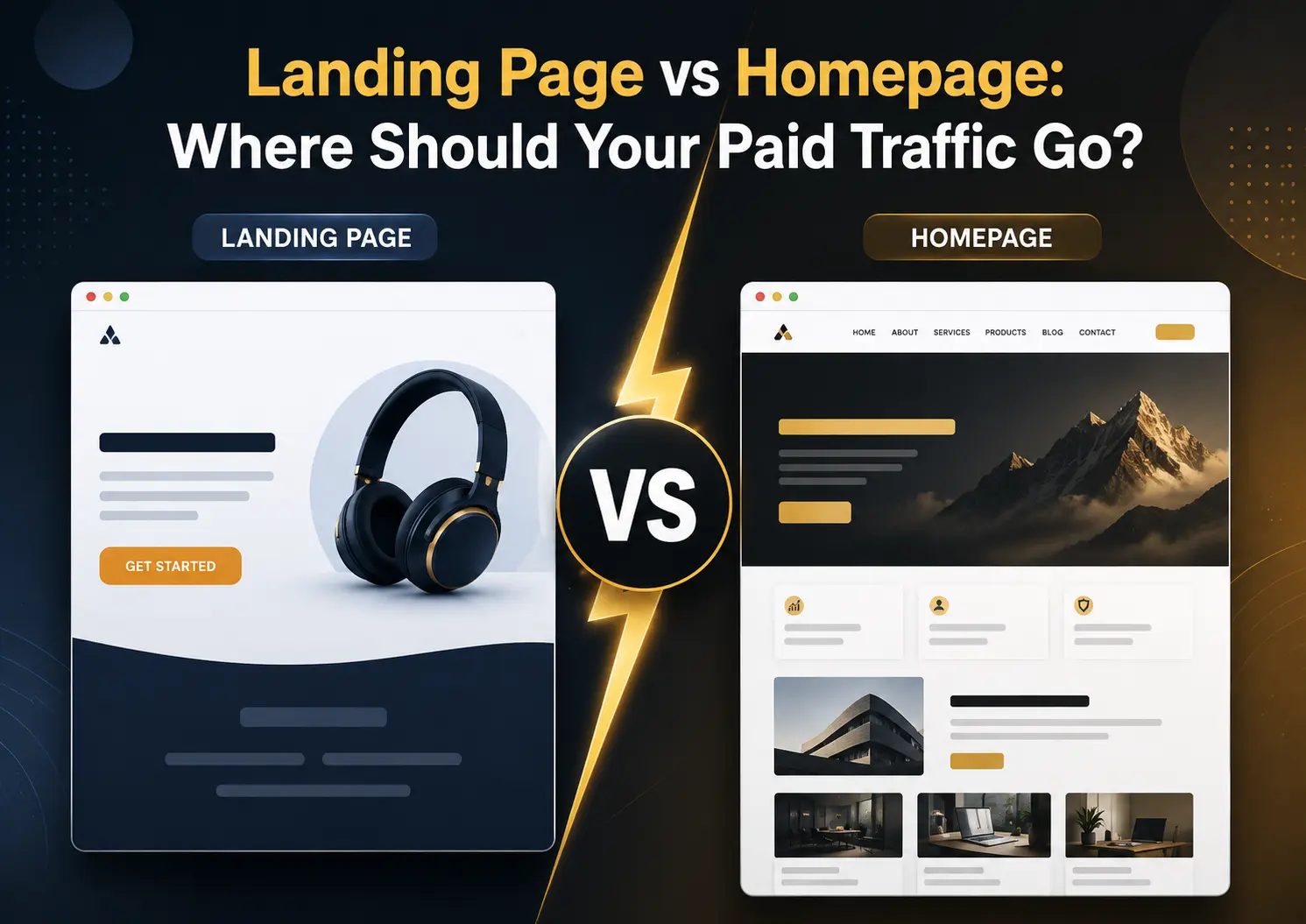
You pay for a click, someone arrives, and then your website asks them to choose between six menu items, three services and the company story. That is the central problem in the landing page vs homepage decision. A homepage introduces the whole business. A campaign page continues one specific conversation. Sending every advert to the homepage is convenient, but convenience is not the same as conversion.
Landing page vs homepage: what changes after the click?
A visitor who searches your brand may genuinely want the homepage. They are still exploring and need navigation, company context and several routes forward. Paid traffic is usually narrower. Someone who clicked an advert for WooCommerce support expects that service, not a general tour. The headline should echo the promise, the evidence should support it and the next action should be obvious.
This is also how advertising platforms assess the destination. Google says landing-page experience considers relevance, useful information, navigation and whether the page meets the expectation created by the advert. Message match therefore helps people and campaign quality at the same time.
When the homepage is still the right answer
Use the homepage for branded campaigns, broad awareness or audiences whose need is not yet clear. It can also work when a small business offers one tightly defined service and the homepage already behaves like a focused sales page. Do not build another URL simply because marketing folklore says every campaign needs one. Build it when the visitor’s intent deserves a different path.
What a focused campaign page needs
A useful landing page is not a homepage with the menu removed. Give it a complete argument:
- One promise. Say what the visitor gets and for whom it is meant.
- One primary action. Request a quote, book a call or buy — do not ask for all three equally.
- Specific proof. Use relevant work, numbers or testimonials rather than generic logos.
- Objection handling. Answer questions about price, timing, process and risk before the form.
- A short form. Ask only for information the first conversation actually needs.
Keep the page fast on mobile, too. Our guide to Core Web Vitals explains the technical baseline, while why beautiful websites fail to convert covers the clarity problem.
Measure the result, not the page
Before launch, define one conversion and make sure analytics records it. Compare conversion rate, qualified-lead rate and cost per useful enquiry — not just bounce rate. Run one meaningful test at a time, starting with the offer or headline before button colours. If the campaign attracts the wrong people, the page cannot rescue the targeting.
The practical answer is simple: keep the homepage for discovery and give valuable, specific campaigns a focused destination. If you want the advert, page and measurement designed as one journey, our team can build the path from first click to genuine enquiry.