
Everything upstream of checkout can be excellent, and you will still lose the sale if the payment step feels wrong. Choosing a payment gateway is therefore a conversion decision as much as a financial one. Fees matter, but so do payout speed, instalments, and whether Greek shoppers recognise the buttons. So let’s compare the realistic options for a Greek shop.
What a payment gateway actually does
Two things sit behind every card payment: the gateway that collects the details, and the acquirer that moves the money. Some providers do both, which simplifies your paperwork. Then compare on seven points:
- Effective cost on your average basket — percentage plus fixed fee, not the headline rate.
- Payout timing. Next-day settlement helps cash flow far more than a slightly lower fee.
- Methods Greek customers expect: cards, Apple Pay and Google Pay, IRIS, instalments, and often cash on delivery.
- Checkout experience. Hosted fields inside your page usually convert better than a redirect to a bank screen.
- Strong customer authentication. Every provider does 3-D Secure, yet the friction differs noticeably.
- WooCommerce plugin quality — actively maintained, or abandoned two years ago.
- Invoicing and accounting integration, which matters more each year as e-invoicing spreads.
The main choices for a Greek shop
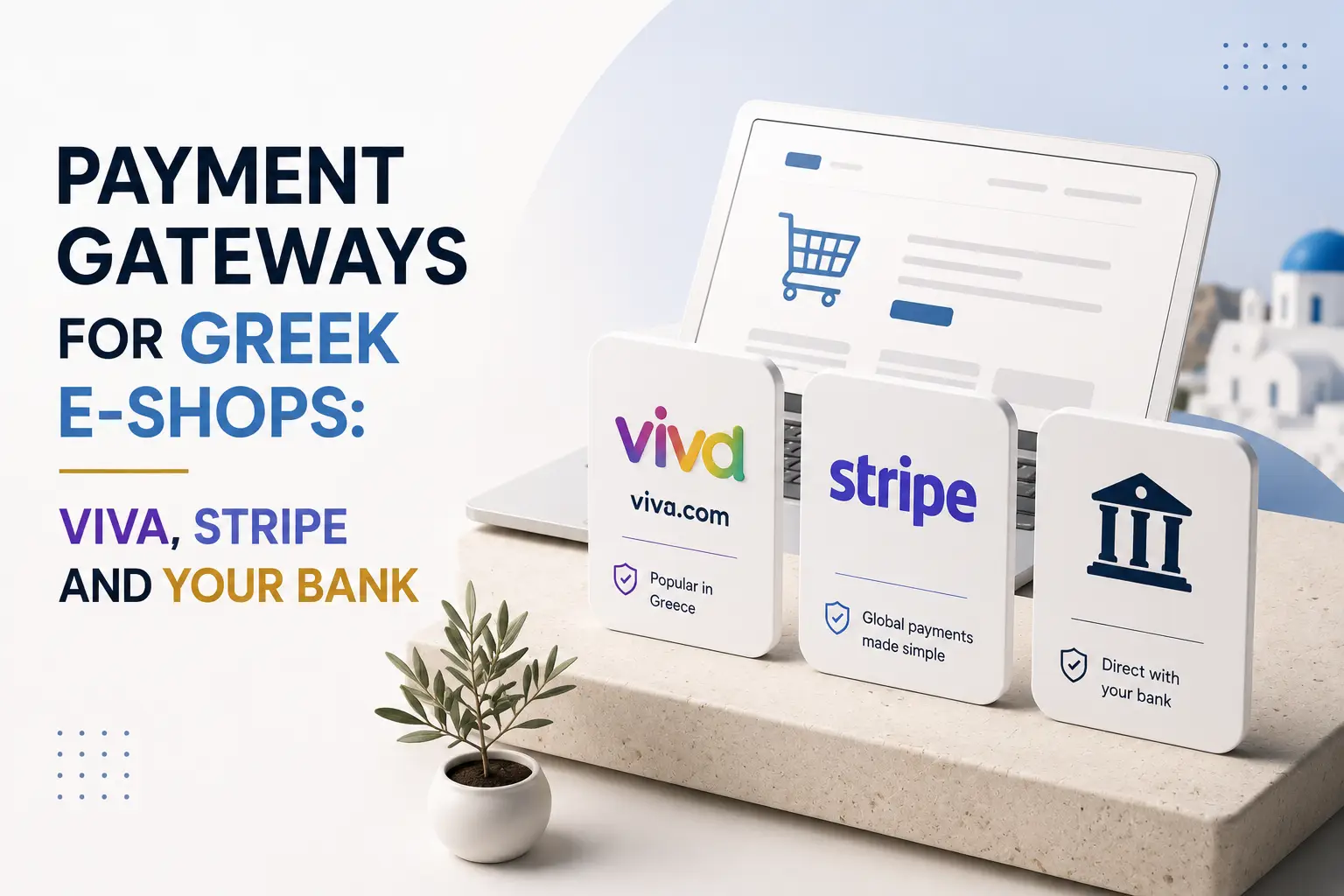
Viva.com is the strongest local all-rounder. It supports the payment habits of Greek buyers, including instalments, and it ties neatly into physical card terminals if you also sell in person. Its own site lists the current methods. Consequently it is our usual first suggestion for a shop selling mainly in Greece.
Stripe wins on engineering. The documentation is excellent, subscriptions and metered billing are first class, and multi-currency selling is straightforward — see their platform. Therefore it is the natural pick for SaaS, digital products and cross-border sales. However, some Greek-specific methods need more work.
Greek bank gateways, reached through providers such as Everypay, Cardlink or Nexi, remain a solid choice — particularly when your bank relationship already gives you good terms and instalment programmes. Meanwhile the checkout can feel dated, and onboarding takes longer. Ask to see a live demo on a phone before committing.
Finally, PayPal works well as a secondary option for cautious or international buyers. Add it alongside cards rather than instead of them.
Details that quietly cost you money
First, offer at least two methods, because a single failing payment gateway means zero revenue that morning. Second, test refunds and partial refunds before launch, not during your first dispute. Third, keep the card fields on your own domain if the provider supports it, since a redirect loses hesitant buyers. Fourth, measure abandonment at the payment step specifically — our post on why beautiful sites fail to convert explains why the last click deserves the most attention.
Also plan the accounting side early. Your gateway, your invoicing system and your order records should agree without a spreadsheet, which becomes essential as B2B e-invoicing expands. And if you are still choosing a platform, our comparison of WooCommerce and Shopify covers what each one supports natively.
In short: Viva.com or a Greek bank gateway for a domestic shop with instalments, Stripe for subscriptions and cross-border, PayPal as a backup. Run the numbers on your real average order value before signing anything. If you want the integration built and tested properly, our team has done it on both platforms.